

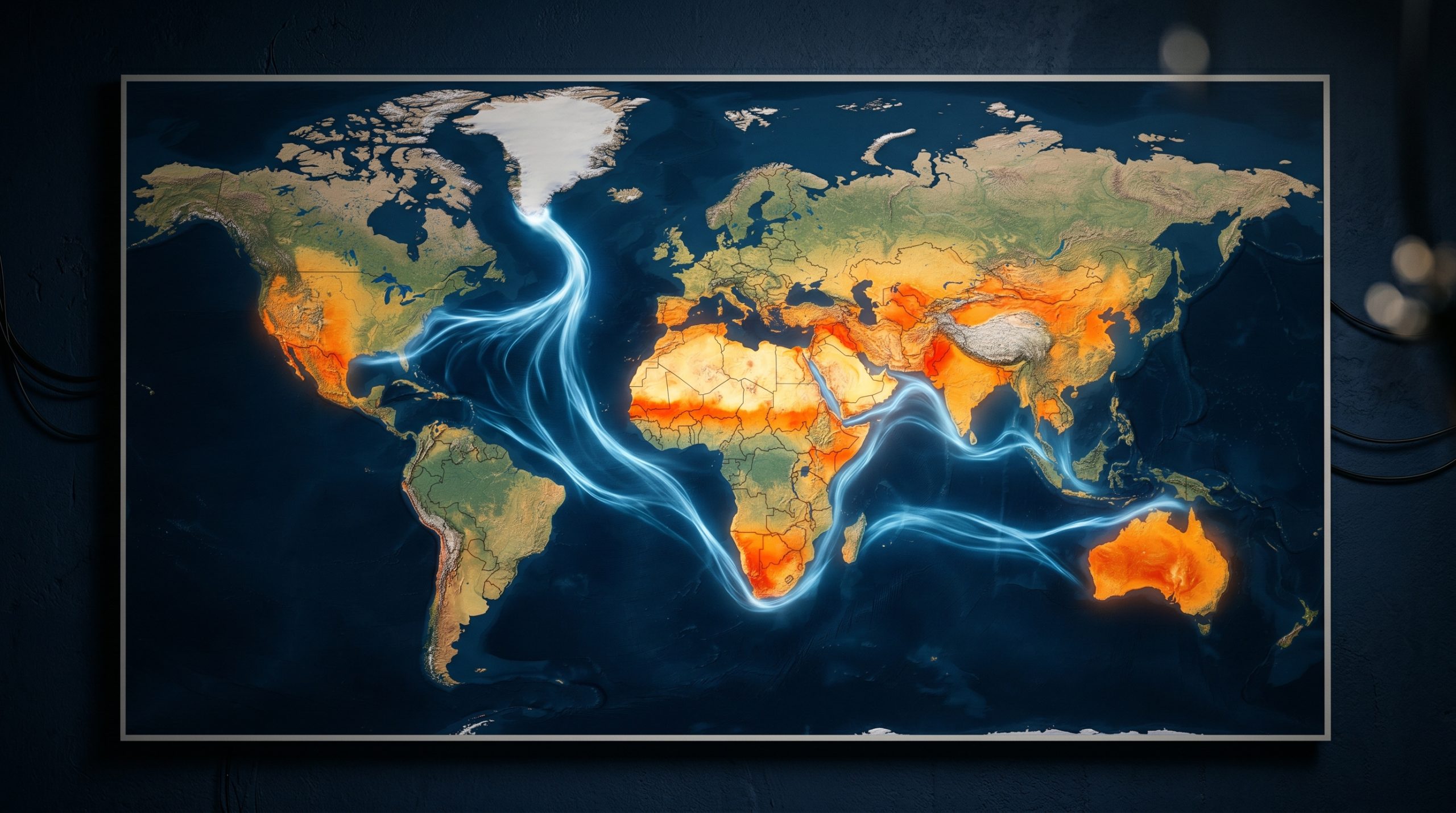

The Middle East holds less than 1% of the world’s renewable freshwater resources while supporting roughly 6% of its population. That gap – between what nature provides and what communities require – is not a future problem. It is the defining infrastructure challenge of the region today.
Root Causes of Water Scarcity in the Middle East
The region’s water crisis stems from three compounding factors: arid climate, population growth, and aquifer depletion. Annual renewable freshwater availability across the Arabian Peninsula averages below 100 cubic meters per person – compared to a global average of roughly 6,000 cubic meters. The World Health Organization defines water scarcity as anything below 1,000 cubic meters per person annually.
Countries like Kuwait, Bahrain, Qatar, and the UAE have essentially no permanent rivers and rely almost entirely on groundwater and desalination for their freshwater supply. Saudi Arabia, the largest country in the region, has drawn down non-renewable fossil aquifers – primarily the vast Saq aquifer – at rates that cannot be replenished on any human timescale. The FAO AQUASTAT database shows Saudi Arabia’s total renewable water resources at approximately 2.4 billion cubic meters per year, against annual withdrawals several times higher.
Desalination: The Dominant Solution
The Gulf states have responded to water scarcity by building the largest desalination infrastructure in the world. Saudi Arabia alone operates more than 30 major desalination plants, producing over 5 million cubic meters per day. The UAE, Kuwait, and Qatar are among the top 10 desalination nations globally by installed capacity.
Early Middle Eastern desalination relied heavily on Multi-Stage Flash (MSF) thermal distillation, which was energy-intensive but suited to facilities co-located with oil refineries and power plants. Over the past two decades, reverse osmosis (RO) has displaced MSF as the technology of choice for new installations. Modern large-scale SWRO plants in the region achieve energy consumption below 3.5 kWh per cubic meter – dramatically lower than MSF’s 10-15 kWh per cubic meter – while producing equivalent water quality.
The International Desalination Association (IDA) reports that the Middle East accounts for approximately 48% of global desalination capacity, with the Gulf Cooperation Council (GCC) countries driving the majority of new project investment.
Beyond the Gulf: Water Stress in Jordan, Lebanon, and Iraq
While the Gulf states have addressed water scarcity through desalination funded by oil revenues, countries without that economic advantage face more acute crises. Jordan is consistently ranked among the world’s most water-scarce nations – its per capita renewable freshwater availability is roughly 60-70 cubic meters per year, below Kuwait’s. The country depends heavily on the Jordan River basin, shared with Israel and the Palestinian territories, and on the overdrawn Disi fossil aquifer.
Iraq, despite hosting the Tigris and Euphrates rivers, faces deteriorating water quality from upstream damming in Turkey and Syria, agricultural runoff, and decades of infrastructure underinvestment. Lebanon’s water infrastructure suffered severe damage in the 2020 Beirut port explosion and faces chronic mismanagement of its mountain spring resources.
Water Management Strategies Emerging in the Region
Governments across the Middle East are pursuing several parallel strategies to close the supply gap:
- Wastewater reuse: Israel leads the region – and the world – in treated wastewater reuse for agriculture, recycling approximately 85% of municipal wastewater for irrigation. Saudi Arabia and the UAE are scaling similar programs.
- Agricultural efficiency: Traditional flood irrigation, which loses 40-60% of applied water to evaporation, is being replaced with drip and micro-irrigation systems. Saudi Arabia has also scaled back wheat cultivation to reduce agricultural water demand.
- Solar-powered desalination: With some of the highest solar irradiance levels on the planet, Middle Eastern countries are increasingly pairing photovoltaic arrays with RO systems to reduce the carbon and cost burden of desalination. IRENA projects solar desalination capacity growing fivefold in the region by 2030.
- Aquifer recharge: The UAE runs managed aquifer recharge (MAR) programs to bank excess desalination output in underground reserves for emergency use.
How AMPAC USA Systems Support Regional Projects
AMPAC USA designs and manufactures seawater reverse osmosis systems, brackish water RO units, and containerized water treatment systems engineered for deployment in challenging environments – including remote Gulf sites, military forward operating bases, and humanitarian relief operations across the Middle East and North Africa.
Our systems operate across a full range of source water types – high-salinity Gulf seawater, brackish inland aquifer water, and blended source streams – with energy recovery devices to minimize operating costs in off-grid or diesel-powered installations. For project inquiries, contact AMPAC USA.
Frequently Asked Questions
What are the primary causes of water scarcity in the Middle East?
The Middle East’s severe water scarcity stems from an arid climate, rapid population growth, and significant aquifer depletion. The region holds less than 1% of global renewable freshwater resources, supporting roughly 6% of the world’s population, leading to an average availability below 100 cubic meters per person annually in the Arabian Peninsula.
How have Middle Eastern countries addressed severe water shortages?
Gulf states have primarily addressed water shortages by developing the world’s largest desalination infrastructure. Countries like Saudi Arabia operate over 30 major plants, producing more than 5 million cubic meters of freshwater daily, with the UAE, Kuwait, and Qatar also ranking among the top global desalination nations.
What desalination technology is most commonly used in the Middle East today?
Reverse osmosis (RO) has become the preferred desalination technology for new installations in the Middle East, displacing older Multi-Stage Flash (MSF) thermal distillation. Modern large-scale SWRO plants achieve significantly lower energy consumption, typically below 3.5 kWh per cubic meter, compared to MSF’s 10-15 kWh per cubic meter.
Which Middle Eastern countries rely almost entirely on desalination and groundwater?
Countries such as Kuwait, Bahrain, Qatar, and the UAE have virtually no permanent rivers and depend almost entirely on groundwater and desalination for their freshwater supply. Saudi Arabia, while larger, also heavily utilizes desalination and has drawn down non-renewable fossil aquifers like the vast Saq aquifer at unsustainable rates.
What percentage of global desalination capacity is located in the Middle East?
The Middle East accounts for approximately 48% of the global desalination capacity, according to the International Desalination Association (IDA). The Gulf Cooperation Council (GCC) countries are the primary drivers of new project investment in this sector, highlighting the region’s critical reliance on this technology.
Related Articles
- Solutions For Water Scarcity and Water Hazards- What the UN Says About it?
- The Global Perspective: How Commercial RO is Addressing Water Scarcity Challenges
- How Can Seawater Desalination Contribute to Water Security in the Middle East?
- PFAS Contamination Near Military Bases and Airports: Water Treatment Guide
Conclusion
The numbers explain why desalination isn’t optional in this region — with less than 1% of the world’s renewable freshwater supporting roughly 6% of its population, Gulf states had to build alternative supply at scale, and they did: the region now accounts for something like 48% of global desalination capacity. The shift toward modern SWRO plants running below 3.5 kWh per cubic meter, instead of older thermal methods burning through 10-15 kWh, is also making that capacity cheaper to sustain long-term. For more on how this technology specifically supports the region, see How Can Seawater Desalination Contribute to Water Security in the Middle East?. Contact our team at info@ampac1.com or (909) 548-4900 to discuss desalination or water treatment options for water-stressed regions.
AMPAC USA engineers custom water purification systems for commercial, industrial, and emergency applications — from 500 GPD to multi-million GPD. Trusted by municipalities, military, and industry worldwide.
