
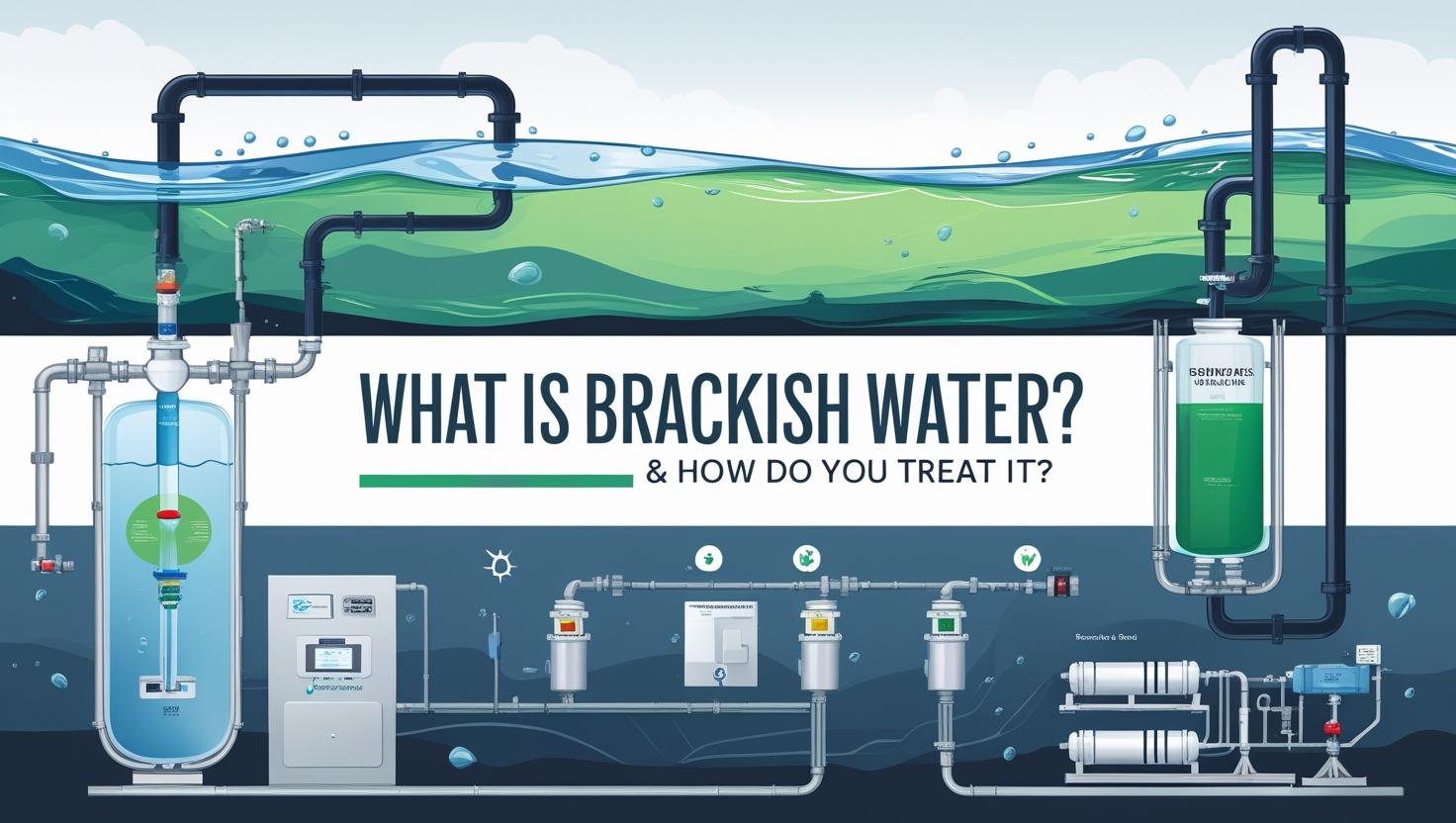
Brackish water sits in a salinity range between freshwater and seawater — typically 1,000 to 10,000 parts per million (ppm) of total dissolved solids (TDS). It’s too salty to drink untreated and too fresh to be considered seawater, which puts it in a treatment category of its own. Brackish water reverse osmosis systems are the standard solution for industries and municipalities that draw from these sources.
You encounter brackish water most often in estuaries where rivers meet the ocean, in coastal aquifers that have seen saltwater intrusion, in agricultural drainage systems, and in produced water from oil and gas operations. For industrial facilities and municipalities drawing from these sources, the salinity level requires a purpose-built treatment approach.
How Brackish Water Differs from Seawater
Seawater runs at roughly 35,000 ppm TDS. Brackish water is anywhere from 3% to 29% as saline. That difference matters enormously for treatment design: a seawater reverse osmosis (SWRO) system operates at 800–1,200 psi of feed pressure, while a brackish water RO (BWRO) system typically runs at 150–400 psi. Lower pressure means lower energy consumption — often 0.5–1.5 kWh per 1,000 gallons for brackish RO versus 3–6 kWh for seawater RO. The U.S. Environmental Protection Agency classifies brackish groundwater as a key alternative water source in water-stressed regions.
Effective Treatment Methods for Brackish Water
Reverse osmosis is the standard for brackish water purification. A properly designed BWRO system will remove 95–99% of dissolved salts, heavy metals, nitrates, and most organic contaminants in a single pass. The key design variables are the TDS of the source, the desired permeate quality, and the required flow rate.
Pre-Treatment Requirements
Pre-treatment ahead of the RO membranes typically includes multimedia filtration to remove suspended solids, activated carbon to strip chlorine and organics that would degrade the membrane, and antiscalant dosing to prevent calcium carbonate and sulfate scaling on the membrane surface. The American Water Works Association (AWWA) recommends SDI (Silt Density Index) testing before sizing any membrane system.
Two-Pass RO for High-TDS Sources
For very high-TDS brackish water above 5,000 ppm, a two-pass RO configuration may be appropriate, running permeate from the first membrane stage through a second set of membranes to achieve pharmaceutical-grade or boiler-feed-quality output.
Ion Exchange as a Polishing Step
Ion exchange is an alternative for lower-volume applications or for polishing after RO, particularly when specific ions like nitrates or hardness minerals are the primary concern. NSF International certifies both RO membranes and ion exchange resins under Standards 58 and 44 respectively.
Brackish Water vs. Seawater: Which System Do You Need?
| Parameter | Brackish Water RO | Seawater RO |
|---|---|---|
| Source TDS | 1,000–10,000 ppm | 30,000–45,000 ppm |
| Operating Pressure | 150–400 psi | 800–1,200 psi |
| Energy Use | 0.5–1.5 kWh/1,000 gal | 3–6 kWh/1,000 gal |
| Salt Rejection | 95–99% | 99–99.8% |
Industrial Applications for Brackish Water Treatment
- Municipal water supply: Coastal cities augmenting freshwater supplies with treated brackish groundwater
- Power generation: Boiler feed water requiring low-conductivity input
- Food and beverage: Process water and ingredient water requiring consistent TDS
- Pharmaceutical manufacturing: USP purified water production from brackish sources
- Agricultural irrigation: Treated brackish water for salt-sensitive crops
AMPAC USA Brackish Water RO Systems
AMPAC USA designs industrial brackish water reverse osmosis systems from 500 gallons per day for small communities to multi-million gallon-per-day industrial plants. Each system is engineered to the actual TDS profile of the source water — there is no one-size-fits-all configuration for brackish sources, which vary widely in their ionic composition depending on geology, proximity to the coast, and agricultural runoff patterns.
If you are evaluating a brackish water treatment project, the first step is a complete source water analysis. Our engineering team can review your water quality data and specify the right membrane configuration, pre-treatment train, and recovery ratio for your application. Explore our commercial RO systems or browse our water treatment blog for more technical guides.