
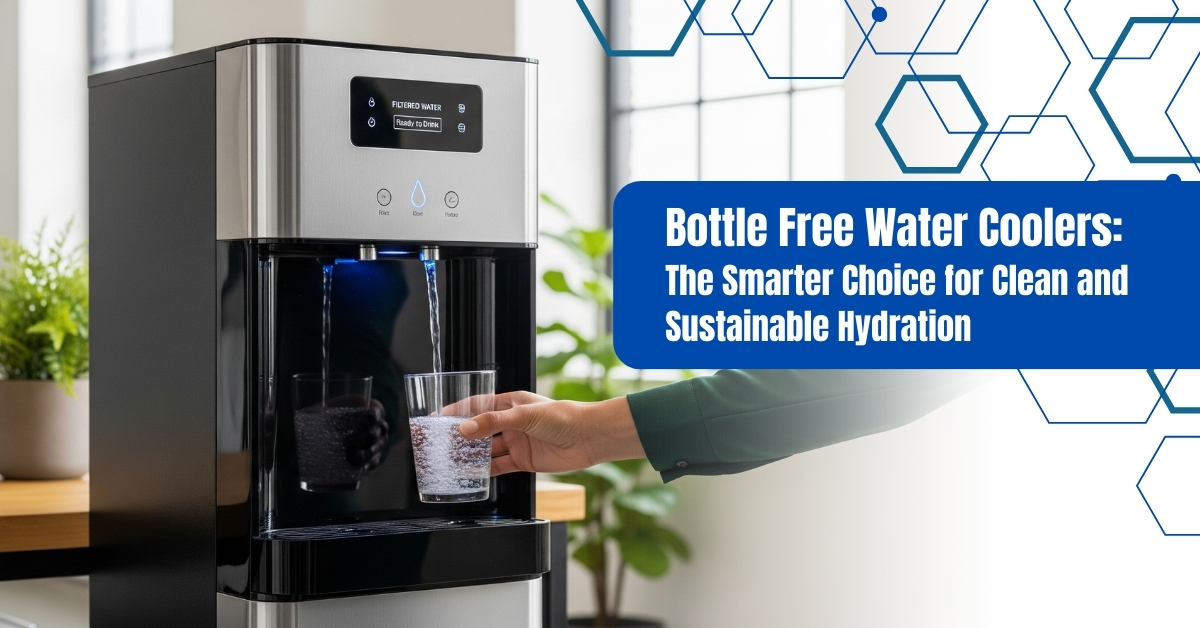
A bottle-free water cooler connects directly to your building’s water supply and filters it on demand, eliminating the need for delivered 5-gallon jugs. For offices, schools, gyms, and healthcare facilities, the shift from bottled to point-of-use makes sense on three fronts: cost, water quality, and environmental footprint. Bottle-free water coolers — also called point-of-use (POU) coolers — are now the preferred choice for facilities managers prioritizing both sustainability and water purity.
The Problem With Delivered Water Coolers
A standard 5-gallon office cooler refill costs $7–$15 per bottle, depending on region and supplier. A busy office consuming 4–6 bottles per week spends $1,500–$4,500 per year on water delivery alone, before factoring in the cooler rental fee. The EPA estimates that significant water and energy is wasted in bottled water production and delivery logistics each year.
Bottled water coolers are also harder to keep clean. The reservoir in a standard cooler is a warm, dark space that accumulates biofilm if not sanitized on a strict schedule. Many facilities skip sanitization cycles, creating a genuine contamination risk despite the appearance of clean water.
How Bottle-Free Water Coolers Work
Point-of-use coolers tap into the cold water line and pass the incoming water through a multi-stage filtration system — typically a sediment pre-filter, activated carbon block for chlorine and organics, and in some models a reverse osmosis membrane for dissolved solids reduction. Filtered water is then chilled in a stainless-steel tank and dispensed hot, cold, or at room temperature.
Because the system is plumbed directly, there is no bottle storage, no delivery scheduling, and no risk of running out. The filtration cartridges require replacement every 6–12 months, which is the system’s primary ongoing cost. NSF International certifies the filtration components used in quality POU systems, ensuring contaminant reduction claims are independently verified.
Cost Comparison: Bottled vs. Bottle-Free
| Delivered 5-Gallon Cooler | Bottle-Free POU Cooler | |
|---|---|---|
| Upfront Cost | $0–$100 (rental) | $400–$1,200 |
| Annual Consumables | $1,500–$4,500 (bottles) | $100–$200 (filters) |
| Delivery Management | Required weekly/bi-weekly | None |
| Typical Payback Period | — | 12–18 months |
| Water Quality Control | Supplier-dependent | On-site filtration |
Filtration Options for Bottle-Free Systems
Carbon Filtration Only
Entry-level POU coolers use activated carbon to remove chlorine, chloramines, and taste/odor compounds. Suitable for municipal water supplies with low TDS and no heavy metal concerns.
Reverse Osmosis Integration
Premium bottle-free coolers integrate a reverse osmosis membrane that removes dissolved solids, lead, nitrates, and PFAS. This is the appropriate configuration for facilities in areas with known water quality concerns or for healthcare and food service environments requiring consistent purity. AMPAC USA specializes in industrial and commercial RO systems that can integrate with POU dispensing units.
Which Industries Benefit Most?
- Offices and co-working spaces: Eliminates delivery logistics and reduces plastic waste
- Healthcare facilities: Consistent purity required for patient and staff hydration
- Schools and universities: Cost-effective hydration at scale with no plastic waste
- Food and beverage manufacturing: RO-integrated coolers provide process-quality water on demand
- Gyms and fitness centers: High-volume demand without constant bottle management
AMPAC USA Commercial Water Solutions
AMPAC USA supplies commercial water purification systems including RO-integrated configurations for large-scale facilities. For facilities requiring high-purity water or serving multiple hydration points, our engineering team can specify the right system configuration. Learn more about water treatment chemicals and maintenance requirements on our blog, or contact us at ampac1.com.